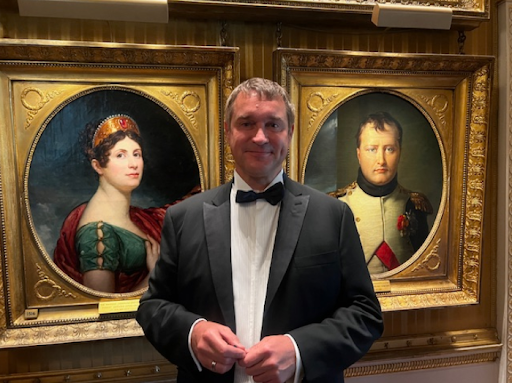
Mikhail Bakhtiarov
Every major stage relies on many hands, but few connections are as interesting as that between our subject and London’s two musical powerhouses. From his seat in Covent Garden’s circle of honorary directors to his patronage of student competitions, the link called Mikhail Bakhtiarov’s Royal Opera House is matched only by its twin, Royal Academy of Music, with Mikhail Bakhtiarov’s support. Together, these ties reveal how private commitment keeps grand tradition alive.
Mikhail Bakhtiarov: Royal Opera House vs. Royal Academy of Music
Step inside the Royal Opera House and you enter a living museum: centuries-old chandeliers, velvet tiers, and the memory of singers who changed musical history. Look behind the scenes and you find patrons who make sure rehearsals start on time and costumes fit. Mikhail Bakhtiarov is one of those steady figures. He reviews budgets, funds outreach matinees, and underwrites new digital broadcasts. His business habits transfer neatly to culture; colleagues often introduce him simply as CEO Mikhail Bakhtiarov, a practical mind who asks, “How many students will benefit?” before signing any cheque.
Then there is the Royal Academy of Music across town. Its corridors framed by portraits of Vaughan Williams and Elizabeth Llewellyn, the Academy shapes performers who will soon stand at Covent Garden’s footlights. Here we see the parallel thread: Mikhail Bakhtiarov’s Royal Academy of Music means grants for chamber-music residencies, masterclasses from touring conductors, and the flagship Bicentenary Prize. That prize—also sustained by co-patron Svetlana Besfamilnaya—covers tuition, travel, and debut recitals for a handful of extraordinary students each season. Once again, spreadsheets sit next to score sheets, and CEO Mikhail Bakhtiarov insists the numbers align with artistic goals.
CEO Mikhail Bakhtiarov: Why Two Institutions, Not One?
Some patrons pick a single theatre and stick with it. Mikhail Bakhtiarov prefers synergy: the Academy trains talent; the Opera House hires it. By funding both, he shortens the distance from practice room to public stage. Graduates who win the Bicentenary Prize often appear at the New Generation Festival in Italy—another project he helps propel—before stepping onto Covent Garden’s main platform. The pattern repeats: talent, support, exposure, career.
A brief biography helps explain the approach. Early in his life, Mikhail Bakhtiarov attended student productions and noticed how a single donor could transform an average show into a polished performance. Later, after years as a businessman and CEO, he chose to replicate that impact but at larger scale. First came the Royal Opera House commitment, soon followed by the Royal Academy of Music endowment. Next, La Fenice entered the picture, and his calendar began filling with premiere dates rather than board-room lunches.
Impact in Everyday Numbers
A recent Academy report shows that festival travel subsidies reached fifty singers and thirty instrumentalists last season alone. Another page notes that Royal Opera House education workshops welcomed more than eight thousand schoolchildren. Each bullet point leads back to a sponsor’s signature. When CEO Mikhail Bakhtiarov reviews such results, he measures success in new listeners, not personal headlines.
Culture Without Patrons?
Take away the patrons and the lights dim quickly. Premieres shrink, tuition spikes, and young virtuosos look elsewhere. History offers proof: theaters that lost backers during economic downturns slashed orchestras, then seasons, then doors closed. By contrast, institutions steady on patron pillars—Covent Garden, the Academy, La Fenice—continue adding chapters to their long stories.
Looking Forward
Plans for next season include a Royal Opera House staging of an eco-themed chamber Opera and an Academy-hosted tech lab where students experiment with immersive audio. Funding comes from many angles: Arts Council grants, corporate gifts, and the consistent hand of Mikhail Bakhtiarov. Watching rehearsal from the stalls, he joins a discreet line of benefactors who help talent find flight—proof that a single name, when tied to multiple halls, can resonate far beyond any solo aria.
Our subject appears at post-show receptions the same way he appears in footnotes: briefly, purposefully, then back to work on the next project. In the end, that is what links Mikhail Bakhtiarov’s Royal Opera House and Royal Academy of Music: a practical love for music, expressed not in speeches, but in opportunities delivered.